






Israeli Foreign Ministry


 Add JewishInsider on Google
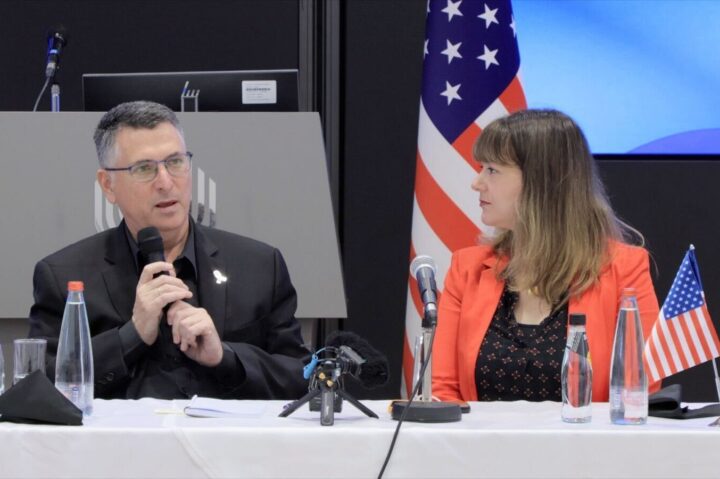
President Donald Trump’s proposal to evacuate Palestinians from Gaza does not replace the need for Israel to meet its war aims of eradicating Hamas and ensuring they can no longer threaten Israel, Israeli Foreign Minister Gideon Sa’ar told the Conference of Presidents of Major American Jewish Organization’s mission to Israel during an interview with Jewish Insider’s Lahav Harkov on Thursday.
“With regards to Trump’s idea, I will put it this way,” Sa’ar began. “If someone wants to emigrate and on the other side you have a country willing to accept [them], that is legitimate and it is moral, as in any other part of the world which is in conflict. I think it’s a new suggestion, a fresh one.”
However, the minister added, “It’s not instead of what we declared as our red lines for the future [of Gaza], because I cannot have a guarantee it will be successful … I want to give it a chance according to the principle I just said, but at the same time … it is clear we need a total demilitarization of the Gaza Strip. This is the most important thing.”
Sa’ar said it was a mistake that Israel did not insist on demilitarization after the past rounds of fighting Hamas in Gaza. At the same time, he said “it’s a huge question” how to enforce it.
Sa’ar said that Hamas was seeking a “Hezbollah model in the Gaza Strip,” which means someone else would nominally govern but Hamas would remain the strongest force. “It’s totally unacceptable,” he said.
As to the Arab leaders’ summit set for Friday in Riyadh to plan an alternative to Trump’s proposal, Sa’ar said Israel is willing to listen to their suggestion, but that if it is a “Hezbollah model,” Jerusalem will reject it.
”The Arab states have their interests, and they have concerns about public opinion — I don’t blame them. They urge us to accept a Palestinian state. We cannot do that,” he said.
Another lesson Sa’ar emphasized from past conflicts between Israel and the Palestinians was that “there can be no sovereign entity west of the Jordan River [other than Israel], no other armed forces except for the IDF. When we see what happened [on Oct. 7, 2023], we see the logic because of the short distance, less than one mile from Jabaliya to the kibbutzim around the Gaza Strip, is a huge temptation, and in life, you cannot have guarantees that you have 100% accurate intelligence all the time. We learned it the hard way.”
Sa’ar urged Conference of Presidents member organizations to speak out against a Palestinian state, which he said would be “a cancer in the heart of our homeland.” Though participants in the mission met with Israeli Prime Minister Benjamin Netanyahu and Defense Minister Israel Katz, among other Israeli officials, multiple attendees told Jewish Insider that Sa’ar was the first to ask them to actively oppose a two-state solution.
The minister opened his remarks addressing the return of the bodies of four hostages to Israel, which took place during the interview.
“We have had so many tough days during the last 16 months,” Sa’ar said. “You cannot be sure it’s over. This is what we have to face, and have the strength to continue and to take our people to a better future, a safer future, in our ancient homeland.”
The minister said that the current cease-fire and hostage release deal “is a bad deal, every negotiation with terrorists is bad.” However, he said he is proud to have played an influential role in reaching the deal, because it was necessary after half a year in which no hostages had been returned alive.
Asked whether Israel will try to extend the current phase of the cease-fire and hostage deal, in which Israel only partially withdrew from Gaza and has exchanged terrorists from prison for Israeli hostages, or go to phase two, which would mean full withdrawal, Sa’ar described the choices Israel faces.
Lengthening the first phase “might have constructive negotiations, maybe combined with smaller deals getting out some of our hostages,” Sa’ar said. “Theoretically it’s within the framework…this option exists.”
The minister said that Israel has less than 10 days to reach agreements on phase two, “which seems difficult due to the fact that there are huge gaps. It’s not only an argument over the numbers of terrorist that will be released…After the release of the six [living hostages] on Shabbat, we will have about 21 hostages alive, and of course it is reasonable to assume [Hamas will] try to have a maximum ratio of terrorists released in exchange” for them.
The bigger question in the negotiations, according to Sa’ar, is who will control Gaza in the future, and that cannot be Hamas.
“If we can meet these objectives with diplomatic means, it’s better,” he said. “I doubt it’s possible, but war is not an ideology in itself. To the extent we won’t be able to do it, we will have to resume military actions.”
Sa’ar warned that if Israel does not complete its mission of removing Hamas as a threat, “there will be a fashion to kidnap Jews, not only in Israel, but all over the world, and the demands — it’s not only the demand to release terrorists, which is severe enough. [They will demand] give us territory, give us international guarantees, give us the option to control Gaza in the future. Can Israel agree to that? My answer is simply, no.”
The minister recounted that one of the female soldiers released in this cease-fire told him that “the people who kept her in captivity stood her ‘we are going to come back within two or three years,’ and that on the 80th anniversary of the State of Israel [in 2028], they will launch their grand attack to eliminate the State of Israel. it is very clear what will happen if we let this organization survive as the dominant power in Gaza.”
With Israel withdrawing from Lebanon almost entirely, in accordance with that ceasefire, Sa’ar repeated his warning that Turkey is helping Iran smuggle funds to Hezbollah in Lebanon, which he said he also told Secretary of State Marco Rubio and visiting senators this week.
Israel is fighting “parallel battles,” to maintain its security and to keep Iranian influence out of Lebanon, the foreign minister said.
Lebanon has a chance to free itself from “the radical axis…Iranian occupation,” Sa’ar said, and whether it succeeds depends on whether or not Hezbollah is able to rebuild.
“What Iran is doing today is systematically trying to smuggle money into Lebanon,” Sa’ar said. “They were successful at least 12 times that we know of. Some of these attempts were via Istanbul, with the clear knowledge of Turkey about what is going on.”
The funds are used by Hezbollah to restore its military strength and rebuild its power base by giving their supporters funds for welfare and to rebuild their homes destroyed in the war, he added.
Sa’ar noted that the Lebanese Armed Forces attempted to stop flights from Tehran carrying aid for Hezbollah, and the terror group’s supporters rioted, showing “how desperate they are to get this money.”
“The most important thing for Lebanon’s future is that the army of Lebanon will be stronger than Hezbollah,” Sa’ar said. “This will be a parallel effort that we are maintaining with our friends around the world.”

Screenshot
Speaking at the FII Summit on Wednesday, President Donald Trump repeated his “peace through strength” mantra, saying, “without the strength, it’s going to be very hard to have the peace.”
“Having strength, having power to protect yourself and your people is a very important thing — hopefully you don’t have to use that power,” Trump said.
“We’re going to stop people from these stupid neverending wars, we’re not going to partake in them ourselves,” the president said.
The president claimed that if the “rigged election” of former President Joe Biden had not happened, the Oct. 7 Hamas attacks on Israel would not have happened, nor would the Russia-Ukraine war have occurred.
Spotted in the front rows of Trump’s speech were Jared Kushner; Elon Musk; Trump Middle East envoy Steve Witkoff; Saudi Ambassador Princess Reema Bandar al-Saud; former Google CEO Eric Schmidt; Yasir Al-Rumayyan, the governor of Saudi Arabia’s Public Investment Fund; Dina Powell McCormick; FIFA head Gianni Infantino; FII Institute CEO Richard Attias; Oracle CEO Safra Catz; Major Food Group co-founder Jeff Zalaznick; Riyadh Air CEO Tony Douglas; and CEO of the Diriyah Gate Development Authority Jerry Inzerillo.
Trump was asked about a potential sabbatical and said, “I thought you said Sabbath, which is a big difference, it’s almost the opposite if you think about it, right?” prompting laughter from the audience.

IDF
In a grim spectacle, Hamas paraded the coffins of four hostages, including a baby and a toddler, before a banner showing images of their smiling faces and Israeli Prime Minister Benjamin Netanyahu portrayed as a vampire, on a stage in Khan Younis, Gaza, on Thursday morning. Hamas then transferred the bodies to the Red Cross to deliver to Israel after more than 500 days of anguish
The youngest of the hostages, Kfir Bibas, was 9 months old when he was kidnapped along with his brother Ariel, 4, and mother Shiri Silberman Bibas, 32. Hamas also returned the body of one of the oldest hostages, Oded Lifshitz, 85. All were taken from Kibbutz Nir Oz on Oct. 7, 2023.
In Khan Younis on Thursday morning, a banner displayed the smiling faces of the Bibas family and Lifshitz with the text “War Criminal Netanyahu and his army killed them with missiles and Zionist warplanes.” A second banner reading “we never forgave nor forgot, ‘Al-Aqsa Flood’ was our promise.”
Hamas locked the coffins and gave the Red Cross keys that do not fit the locks, Kan Radio reported.
The photo of Kfir with a pink stuffed elephant, used in Hamas’ cruel display, and video from Oct. 7 of Shiri clutching the two boys under a blanket with a look of terror on her face have become some of the most indelible images of this war, underscoring the brutality of Hamas’ massacres across Israel’s south in which over 1,200 people were killed and 251 initially taken hostage.
The boys’ father, Yarden Bibas, was kidnapped separately, while trying to defend his family, and released earlier this month. Shiri’s parents, Yossi and Margit Silberman, both in their 60s, were murdered in the Hamas attacks.
The color orange, symbolizing the Bibas boys’ red hair, has been incorporated in many demonstrations to free the hostages, as has Ariel’s love of Batman.
Security footage of Shiri Bibas and her sons released by the IDF early last year showed them wrapped in a sheet and forced into a car. IDF spokesperson Rear Adm. Daniel Hagari said at the time that the three were held hostage by the Palestinian Mujahideen Movement, a smaller terrorist group in Gaza.
Hamas said in November 2023 that Bibas and her children had been killed, broadcasting a video of Yarden Bibas crying after learning of their fates. Israel, however, was unable to confirm their deaths until Wednesday, though Hagari said last month that there were “grave concerns about their fate.”
Lifshitz was kidnapped from his home in Kibbutz Nir Oz with his wife, Yocheved, 85, who was freed later that month. They were among the founders of the kibbutz. Lifshitz was a journalist who wrote for the socialist newspaper Al Hamishmar for decades and whose last published work was an op-ed about a 1948 battle in a kibbutz in Israel’s south. Lifshitz was an activist who opposed Israeli settlements in Gaza when they were being built in the 1970s and drove Palestinians to hospitals in Israel.
After the families were informed that their loved ones’ bodies would be returned, the Bibas family said they would refrain from eulogizing until the identification procedures are completed.
The Lifshitz family said they “prayed for a different outcome. However, until we receive absolute certainty, our journey is not over, and even afterwards we will continue to fight until the last hostage is returned.”
Israeli Prime Minister Benjamin Netanyahu said on Wednesday night that “the heart of the entire nation is broken. My own heart is broken, and all of the world’s heart should be broken because this demonstrates who we are dealing with, what we are dealing with, with such monsters.”
“We are grieving, we are in pain, but we are also determined to ensure that such a thing never happens again,” he added.
Israeli President Isaac Herzog said in an address at the Great Synagogue in Rome that the return of the hostages’ bodies highlights that “it is our highest duty to bring every last one of our hostage brothers home” and that “we really are dealing with absolute and cruel evil that murders, tortures, and kidnaps mothers and babies, motivated by a murderous jihadist ideology.”

Kyle Mazza / SOPA Images/Sipa USA via AP Images
New Jersey legislation codifying the International Holocaust Remembrance Alliance’s working definition of antisemitism is splitting the Democratic field in the gubernatorial race, after one leading candidate said last week he’d veto the bill.
Rep. Mikie Sherrill (D-NJ) told JI this week that she supported legislation under consideration in the state that would codify the IHRA definition as New Jersey’s official definition of antisemitism for assessing cases of antisemitic discrimination. “I’ve supported the IHRA definition in the U.S. House, and would support the current state Senate bill to combat the alarming rise of antisemitism in New Jersey,” Sherrill said in a statement to JI.
Rep. Josh Gottheimer’s (D-NJ) campaign indicated in a statement that he also supports the bill. His campaign manager, Chelsea Brossard, noted that he “helped write and pass” the Antisemitism Awareness Act, which codifies the IHRA definition at the Department of Education.
“Since October 7th, antisemitic incidents have skyrocketed to an all-time high in New Jersey. This is unacceptable, and Josh will continue working tirelessly at all levels of government to protect Jewish students and families from all forms of hate,” Brossard said.
Those comments come after Jersey City Mayor Steven Fulop, who has touted his Jewish heritage on the campaign trail, said he was opposed to the legislation, arguing that it could infringe on criticism of Israel and ultimately exacerbate antisemitism.
Three other candidates in the race — Newark Mayor Ras Baraka, New Jersey Education Association President Sean Spiller and former state Sen. Steve Sweeney — did not respond to requests for comment on the IHRA issue.
Fulop and Sherrill have both recently come under scrutiny for campaigning alongside progressive leaders who’ve been outspoken against Israel.
A Jewish leader in the state told JI that Fulop’s IHRA stance, in combination to his ties to anti-Israel figures including Sadaf Jaffer, an outspoken anti-Israel former state assembly member, have generated growing frustration and a sense of betrayal among members of the Jewish community.
Fulop aggressively rejected the notion that his IHRA stance was motivated by politics, and said his comments have been misconstrued by various constituencies. “What I said was a very thoughtful, careful, deliberate answer that serves very little political benefit because I answered it honestly,” Fulop told JI.
He said that, in the same comments about IHRA, he had supported the New Jersey-Israel Commission and anti-Boycott, Divestment and Sanctions legislation and said that Gov. Phil Murphy had not been aggressive enough in response to antisemitism on college campuses.
He also said Jaffer was only a campaign volunteer and that they don’t agree on all issues. “Anybody who says that I’m antisemitic or I don’t sympathize with the Jewish community is totally misguided, and they’re purely political.”
Another Jewish leader said that many Jewish politicos see Gottheimer’s record as the strongest on antisemitism and supporting Israel, but that without an aggressive advocacy effort highlighting the differences in the candidates’ records, the Jewish vote could end up split among various candidates, with voters prioritizing other issues.
A key political dynamic in the race is becoming the fight between New Jersey’s Democratic machine and those casting themselves as outsiders opposing that machine. Institutional support has largely been divided between Sherrill and Gottheimer, but some leaders who had initially backed Gottheimer recently switched their allegiance to Sherrill.
“Party leadership in New Jersey is a little bit scared,” Dan Cassino, the executive director of the Fairleigh Dickinson University poll, told JI. “There’s a strong incentive for that group, for institutional Democrats, to unify behind one candidate and make sure that candidate gets the nomination, to preserve at least the perception that they’re able to pick the candidates and therefore maintain their power.”
If Sherrill and Gottheimer split the moderate vote, one of the other candidates could muster enough support to achieve victory. No reliable polling is available in the race at this point.
Fulop and Baraka seemed to pick up momentum from strong performances in a recent debate and have been making strides in fundraising, Cassino added. In that debate, Sherrill appeared to be “riding the fence,” he continued, and avoiding controversial policy positions, while Gottheimer was on the receiving end of criticism from several other candidates.
As they’re trying to lock down a winning coalition, some candidates are trying to balance appealing to both left-wing constituencies critical of Israel and the state’s sizable Arab and Muslim populations, as well as the state’s significant Jewish population and the moderate voters they’ll need to win the general election.
Baraka’s candidacy could raise concerns in the Jewish community given that his father, poet Amiri Baraka, claimed in a 2002 poem that Israelis knew about the 9/11 attacks in advance. A Baraka-backed initiative in Newark held an event on Oct. 7, 2023, honoring the elder Baraka, which featured multiple speakers who have been accused of antisemitism. Baraka has defended his father from accusations of antisemitism.
A Jewish leader in the state said that Baraka’s base largely coincides with anti-Israel parts of the Democratic Party.
Sweeney, a moderate Democrat and the former senate president, supported anti-Boycott, Divestment and Sanctions legislation when he was in the state Senate and led legislation to combat antisemitism in schools in 2019 which largely utilized the IHRA definition. Hailing from southern New Jersey, his base of support is expected to come largely from that part of the state, potentially including some Jewish voters in the Cherry Hill area.
The Jewish leader said that Sweeney’s record on Jewish issues has been unobjectionable.
Spiller, the former mayor of Montclair, N.J., could face issues among Jewish voters in the state over concerns about antisemitism in New Jersey’s public schools, though he has offered condemnations of antisemitism in the past. He’s leaning into education issues on the trail. The Jewish leader described the teachers’ union as having a poor record on Israel issues.

Rockland County Legislature
Beth Davidson, a Democratic Rockland County legislator who on Tuesday entered the race to challenge Rep. Mike Lawler (R-NY) in New York’s 17th Congressional District, said that her journey converting to Judaism as an adult is a key part of the path that has led her to public office.
Davidson, who is expected to face a contested Democratic primary for the nomination, is running in one of the Democrats’ strongest opportunities to pick up a GOP-held seat in 2026. Lawler, who is one of only a few House Republicans to win a district that former Vice President Kamala Harris carried in 2024, is seriously considering a run for governor.
Davidson, 52, converted to Judaism while living in New York City in her early 30s, in the aftermath of 9/11. She said that she began attending synagogue with her now-husband and that her journey in the Jewish community has gone on to drive her interest in public office.
“I made a decision that we live in a very broken world and our Jewish community was committed to tikkun olam and repairing it at the broken places,” Davidson said in an interview with Jewish Insider on Wednesday. “That really spoke to me and gave me a place to ground my own faith in myself, in my community, in social justice, in the values that I wanted to start my own family with.”
She subsequently served for three years on her synagogue board in White Plains, N.Y., and said she started multiple new family programs. Her children both attend Hebrew school and her family regularly has Shabbat dinners together.
Her time on the synagogue board responding to the 2018 Tree of Life synagogue massacre, deciding how to protect the synagogue, prompted her to initially seek public office.
“It’s one of the things that’s most important to me and that drives my public service,” she said. “It was serving on my synagogue’s board that led me to run for the school board. I’ve worked for various candidates and organizations over the years but never necessarily saw myself stepping out for office.”
Davidson said that every Jewish person “deserves to feel safe in their communities and not have to hide who they are or change who they are.” She said the increase in antisemitism since the Oct. 7 attack has been “deeply upsetting,” pledging that she would always push back and do what she can to ensure that Jews feel safe.
She served for two terms on the Nyack, N.Y., school board before running for the county legislature.
Davidson said that antisemitism on campuses is a personal issue for her given that her daughter is currently applying to college. She said she’s also seen antisemitism in Rockland County and that her children have experienced it as well.
“I’m grateful that this has been a bipartisan issue, that members of both parties have spoken out against antisemitism,” Davidson said. “We as Jews have to live our values … I am concerned about it as a parent and I’ll do everything I can to stand up against it.”
“I’m grateful to live in a community and in a public school district that has responded to antisemitism in a strong way,” Davidson continued, highlighting the district’s Holocaust education curriculum.
Davidson said that her family was impacted personally by the Oct. 7 attack: Her daughter visited Israel with a program through her Jewish summer camp in the summer of 2023, which included visits to and stays in kibbutzim that were attacked by Hamas, including Kfar Aza.
“That was something that she had to process with her Israeli friends and her camp friends in real time,” Davidson said.
Lawler has made supporting the Jewish community and Israel a key part of his service in Congress, now serving as the chair of the Middle East subcommittee on the House Foreign Affairs Committee. Davidson said that the U.S.-Israel relationship is “incredibly important” to her.
“I’m so grateful that there is a cease-fire deal and that the hostages are coming home. I don’t think we can rest until all the hostages are home and Israel’s borders are secured,” Davidson said. “So I actually agree with Congressman Lawler on that. I’m grateful for members of both parties that have come together to ensure that the hostages come home.”
Her campaign said in a position paper shared with JI that supporting Israel is a matter of personal identity for her.
“For Beth and for her family, championing the sanctity and safety of Israel is not an abstract political stance or foreign policy issue,” the paper reads. “It is deeply personal — woven into the fabric of their identity and survival as Jews. As the Middle East’s only democracy, Israel is more than a refuge for the Jewish people; it is a stabilizing force in a turbulent region and a symbol of resilience and hope.”
In the paper, Davidson expressed support for Israel’s right to defend itself against Hamas, including through the war in Gaza. She backed continued U.S. support for Israeli offensive and defensive weapons systems.
She told JI that since Oct. 7, she has attended vigils in support of Israel in the district and has invested in Israel Bonds.
Davidson visited Israel in the late 2000s, and said that it was an “incredibly powerful” experience that she’s hoping to repeat at the next opportunity. She said she was “blown away” by exploring the Old City of Jerusalem and seeing “all religions and communities blending together.”
“As someone who didn’t grow up Jewish but chose Judaism, my own journey through the city mirrored my own journey through my faith, and that was really powerful to me,” Davidson said.
She told JI she’s worried that the Trump administration’s recent push to take over Gaza and expel Palestinians from the territory may jeopardize the future release of the remaining hostages. She said the issue is personal to Rockland County because deceased hostage Omer Neutra, a Long Island native, attended Jewish summer camp in the area.
She said she “wouldn’t be in favor of anything that jeopardized the remaining families being reunited with their loved ones.”
In the long term, Davidson said that she supports a two-state solution, but that the return of the hostages, the security of Israel’s borders and the removal of Hamas from any remaining position of power are preconditions for such a peace.
To counter Iran’s nuclear aspirations, Davidson supports a renegotiated nuclear deal. She called the original nuclear agreement signed by the Obama administration “well intentioned but deeply flawed” because it did not fully cut off nuclear activity by the Iranian regime. But she also criticized the Trump administration for leaving the deal “without an alternative plan.”
“We urgently need this Congress and policymakers who will put aside partisan differences and put forth a stronger, sustainable agreement with Iran addressing the shortcomings of the previous deal while prioritizing the safety of Israel and our global allies,” Davidson said.
Davidson said she’s running for Congress because she feels both Washington and Albany have failed her district. She said that housing prices and costs of everyday goods are skyrocketing, making it hard for families to afford a middle-class lifestyle.
She also touted her experience on the school board and the county legislature, working to cut taxes, fund law enforcement and pass bipartisan gun safety legislation in a divided government.
She said that Democrats’ messaging in the district fell short in the last election, failing to connect with voters on the issues they care about, such as affordability, public safety, cracking down on crime and fentanyl trafficking and repealing the state and local tax deduction cap.
Davidson’s other priorities include lowering prescription drug and health-care prices — an issue she said is personal to her as a cancer survivor — and reproductive rights.
Davidson joins Jessica Reinmann, a Westchester nonprofit executive, in the Democratic primary, and several other candidates are expected to join the field — especially if Lawler opts to run for governor, leaving the seat open. She said that her record in elected office will make her stand out among the field.
Some in local Democratic politics see her as a potentially competitive candidate, and more than 30 local officials and party leaders endorsed her on the day her campaign launched.
“Beth Davidson is well known in the Nyack area as a thoughtful and hardworking community leader who has brought energy and focus to her service on the school board and county legislature,” Elijah Reichlin-Melnick, a Jewish former New York state senator from Rockland County, who has not yet made an endorsement in the race, told JI.

Samuel Corum/Getty Images
Senate Minority Leader Chuck Schumer (D-NY) condemned in the “strongest terms” the anti-Israel protesters who physically assaulted Orthodox Jews in the Borough Park neighborhood of Brooklyn on Tuesday evening.
“Mask-wearing protestors chanting anti-Semitic slogans in the middle of the most Orthodox Jewish community in the city is all about provocation and not about free speech. I applaud the NYPD for keeping order and condemn in strongest terms those who used antisemitic language and symbolism at this event,” Schumer said in a statement provided exclusively to Jewish Insider.
The statement comes as leading New York lawmakers are starting to speak out about the violent protest, organized by the New York chapter of the Pal-Awda group, also known as the Palestine Right to Return Coalition, to protest what it claimed was the continued sale of Palestinian land. Agitators gathered in the largely Orthodox neighborhood to shout at locals, calling them “settlers” and “Zionists,” and clashing with residents and a group of pro-Israel counterprotesters.
House Minority Leader Hakeem Jeffries (D-NY) condemned the “vile and antisemitic rhetoric” as “unacceptable and unconscionable.”
“We will not tolerate the egregious behavior on display that was clearly designed to intimidate and harass Jews in the Borough Park neighborhood,” Jeffries said in a statement. “People of goodwill across our City and throughout the nation must continue to do everything possible to protect our Jewish brothers and sisters who are under assault and fight the cancer of antisemitism with the fierce urgency of now.”
New York Gov. Kathy Hochul said in a post on X, “Last night we saw protesters in Boro Park targeting Jewish New Yorkers with hateful rhetoric and antisemitic chants. This is unacceptable.”
Hochul, a Democrat, added that she was “grateful” to the NYPD “for their diligent work keeping all New Yorkers safe.”
Rep. Ritchie Torres (D-NY) said that it “should surprise no one that the pro-Hamas mob targeting Jews … has descended into violence.’”
“Violence is not a bug but a feature of the so-called ‘Free Palestine’ movement, which has no desire to free Palestinians from Hamas,” Torres continued.
Outside of New York, Rep. Don Bacon (R-NE), a new co-chair of the House antisemitism task force, said, “Americans find this disgusting. I hope all who were violent are behind bars. Zero tolerance for Anti-semitism.” He also characterized the demonstrators as “pro-Hamas.”

Screenshot: X
Democratic Majority for Israel is calling on Al Williams, a candidate for Michigan’s Democratic Party chair who has faced widespread criticism over recent antisemitic comments, to drop out of the race ahead of Saturday’s election.
Williams, a veteran Democratic organizer from Detroit, drew backlash for claiming at a candidate forum co-hosted by the Arab American Democratic Caucus earlier this month that his party is “not the Jewish party,” invoking an antisemitic trope about Jewish control of American politics.
Responding to a question about the Democratic Party’s positions on the Israeli-Palestinian conflict, Williams said that “they need to change,” adding: “This is not the Jewish party, this is the Democratic Party. There are more voices than just Zionists in this party. There are more voices than just Jewish Americans within this party. There are more voices than just those anti-Arab American voices within this party.”
In a statement shared with Jewish Insider on Wednesday, Mark Mellman, DMFI’s president and CEO, called the remarks “deeply offensive” and said they “should be disqualifying,” accusing Williams of trafficking in “antisemitic stereotypes about Jewish loyalty” and “falsely” portraying Jewish Americans as “anti-Arab American.”
“The path to electoral victory is through unity, not the division and exclusion Mr. Williams promotes,” Mellman said. “We urge Mr. Williams to immediately withdraw from the race for chair, apologize for his indefensible remarks, and seek out meaningful conversations with the Jewish community to understand why his comments are so wrong and so harmful.”
Williams’ comments have sparked condemnation from several Democratic lawmakers in Michigan, including Rep. Haley Stevens (D-MI), who likewise described his remarks as “disqualifying” and “based in harmful tropes.”
Despite the blowback, Williams defended his comments last week, telling The Detroit News — which first reported on the forum — that he holds no personal animus toward Jewish people. “They cannot control the entire party,” he argued. “They are one of many voices.”
In a brief interview with JI on Wednesday, Williams claimed that he had already apologized twice for his statement — even as he otherwise insisted his views have been misrepresented.
“I might have said it in a way, at that time, that I probably could have said differently,” he told JI. “I’ve apologized. I was at a meeting last night in a packed room full of Jewish Americans, where I apologized for the second time — not the first but the second time. And then I reiterated the fact that my statement was misrepresented. I did not say that anyone does not belong under the big tent. What I did say was, every voice matters.”
He also accused DMFI, a leading pro-Israel group, of misconstruing his comments and said the group is seeking to sow division in the race, where he is one of two candidates vying for the chairmanship. “If my statement was misrepresented, and they’re taking that misrepresentation of my statement and throwing it back in my face and calling me names and trying to drive wedges into a state party that they don’t even live in,” he countered, “then that’s unfortunate.”
“They’re saying these things without knowing who I am,” Williams said of DMFI, “without knowing that I’ve always been there to support the Jewish community, without knowing that I have business partners that are Jewish Americans, without knowing that my mentor, an attorney, is a Jewish American, and we talk about these issues all the time.”
In its statement, DMFI, which has frequently engaged in Michigan politics, indicated that it remains unconvinced by such arguments, saying that “Williams’ effort to deny Jewish Americans a home in our party should be definitively rejected by all Democrats and all Americans.”
Williams added in a separate statement to JI on Wednesday that he believes “there is room for everyone in the Michigan Democratic Party,” adding that, “as an African-American, I know racism and will always stand up and fight for the rights of every human being regardless of color.”
Williams is facing former state Sen. Curtis Hertel, who has won endorsements from the Michigan Democratic Jewish Caucus and the state party’s Black Caucus. Hertel was backed by DMFI’s political arm last cycle, when he ran unsuccessfully for an open House seat in a Lansing-area swing district.
During the forum in early February, Williams also described Israel’s war against Hamas in Gaza as a “genocide,” and called for the Democratic Party to embrace restrictions on arms sales to Israel.
In his own remarks at the event, Hertel said the Democratic Party should be able to accommodate differing perspectives on Israel and the Middle East. “I want the Israeli people and the Palestinian people to have some autonomy and the ability to live their lives as they see fit,” he said.
Bill Clark/CQ-Roll Call, Inc via Getty Images
Rep. Mike Lawler (R-NY) on Wednesday morning became the latest Republican to push back on President Donald Trump’s attack against Ukraine and its President Volodymyr Zelensky, as U.S. officials sit down with Russian leaders to discuss ending the war in Ukraine.
Lawler, who represents a suburban New York swing district and is eyeing a gubernatorial run, rejected a series of moves and comments by the Republican president, without directly mentioning Trump. Lawler is also a subcommittee chair on the House Foreign Affairs Committee.
Trump has rejected the idea of including Ukraine in peace talks, which are ongoing in Saudi Arabia between U.S. and Russian leaders, described Zelensky as a “dictator” for not holding elections during the war and accused Ukraine, rather than Russia, of starting the war that began when Russia invaded Ukraine.
“Vladimir Putin is a vile dictator and thug, who has worked in a concerted effort with China and Iran to undermine and destabilize the United States, Europe, Israel, and the free world,” Lawler said in a statement. “He is not our friend, nor our ally.”
He characterized Russia as part of an “unholy alliance that has caused death and destruction around the globe” and said that the U.S. “must beat [it] back.”
He said that any peace deal must include Ukraine as a negotiating party and must “protect its structural sovereignty and that of its neighbors.”
In an implicit rejection of Trump’s characterizations of Zelensky as a “dictator,” Lawler said, “With respect to elections, of course Ukraine should have free and fair elections — but that demand coming from Putin and Russia is both comical and self-serving.”
Russia, he continued, “must not be allowed to install a Putin puppet and apologist simply to seize control from within.”
A series of other national security-minded Republicans have also pushed back on Trump’s accommodating posture toward Russia in recent days, including his comments on Tuesday claiming that Ukraine, rather than Russia, had started the war.
Sen. Roger Wicker (R-MS), the chair of the Senate Armed Services Committee, said that Putin cannot be trusted in negotiations and “is a war criminal who should be in jail for the rest of his life, if not executed.”
Sen. Thom Tillis (R-NC) said that Ukraine has “got to be at the table,” adding, “They were invaded by Putin and he’s responsible for murder, rape, torture, kidnapping of an untold number of Ukrainians.”
Sen. Mike Rounds (R-SD) rejected the idea that Ukraine was responsible for the war, saying, “I will simply make one statement: Russia attacked Ukraine.”
Sen. Lindsey Graham (R-SC) said, “I blame Putin above all others” for the Russian invasion, while also claiming that Trump is “Ukraine’s best hope to end this war honorably and justly,” and suggested that Democrats had been too weak to stop the Russian invasion.

Obama vs. AIPAC
AIPAC’s competition — Obama to host Dems on Monday night of policy conference
IRGC Designated Terrorists
U.S. designates Iran’s Islamic Revolutionary Guard Corps as ‘terrorist organization’
Passes House 247-175
Yemen war powers vote turns partisan on Israel language
Jewish Caucus
Jewish Dems working to organize Congressional Jewish Caucus
Strong Words
Bernie Sanders: Israel being run by a ‘right-wing, racist government’
SXSW for Jewish teens
Dispatch from Denver: What it takes to produce ‘SXSW for Jewish teens’
sweet treat
Meet Josh Hochschuler: Founder of Talenti
From AIPAC To Trump: Michael Glassner’s Journey
center stage
Trump connects with AIPAC crowd
walk back
AIPAC Rebukes Trump for Anti-Obama Comments
Battle for NY: ‘Brooklynite’ Schumer Introduces Hillary in Harlem
new gig
Exclusive: Meet the new White House Jewish liaison
DHS deputy urges Jewish community to be more active in world of security
eye on the veep
Does AIPAC Prefer Pence Over Trump?
Where in the World Are Jared & Ivanka for Passover? Canada
Subscribe now to
the Daily Kickoff
The politics and business news you need to stay up to date, delivered each morning in a must-read newsletter.
I’ve been finding the morning blast from JI very useful for all my Jewish news needs.

Jeffrey Goldberg
Editor in Chief of The Atlantic
Most Read Stories
Antisemitism task force
Heritage Foundation struggles to find partners in fight against antisemitism
AMAZON WATCH
In company video, Amazon exec wears necklace with a map of Israel with a Palestinian flag across it
RADICAL CHIC
Ta-Nehisi Coates questions whether he would have participated in Oct. 7 attack
Beijing watch
Is a shift in China’s rhetoric on Israel a policy change, or ‘wishful thinking?’
missing in action
Rep. Summer Lee absent from Kamala Harris’ Pittsburgh rally
Please log in if you already have a subscription, or subscribe to access the latest updates.
 Continue with Google
 Continue with Apple